
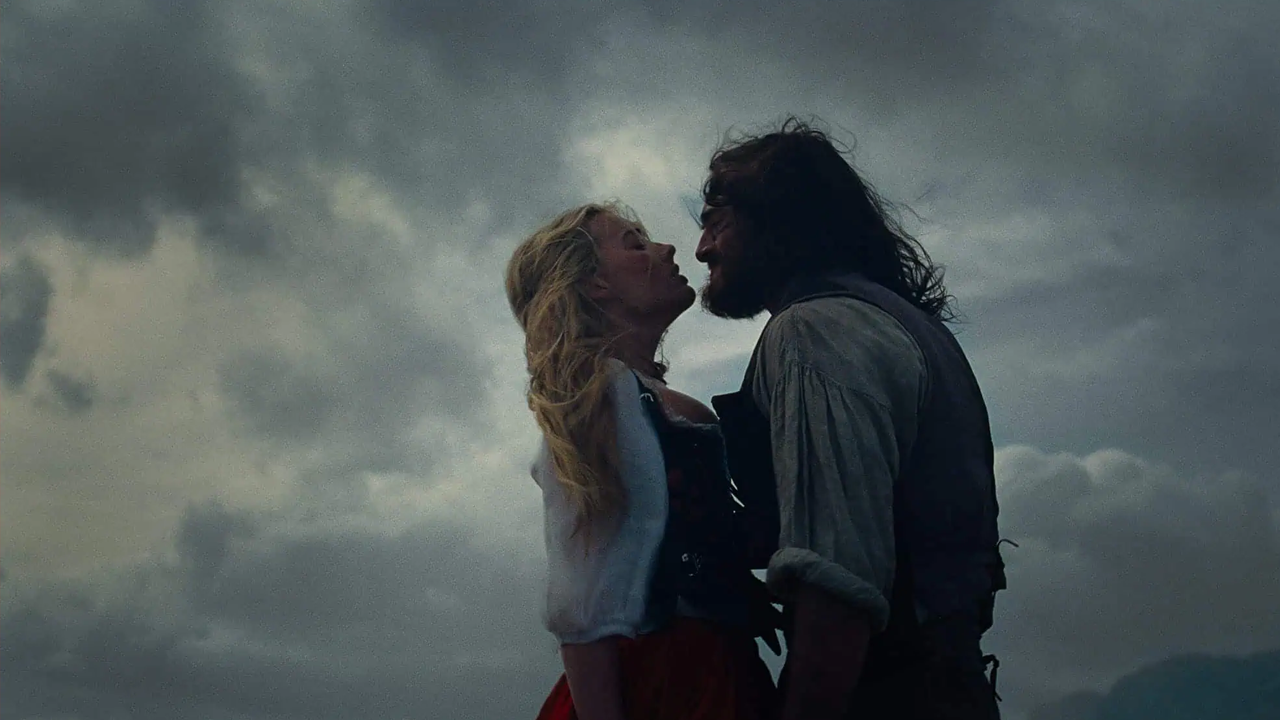
“Wuthering Heights” channels the Baz Luhrmann take on William Shakespeare’s Romeo and Juliet with a dash of Saltburn and Promising Young Woman making it feel like a integral part of Fennell’s work.
“WUTHERING HEIGHTS” (2026)
★★★★ OF ★★★★★ stars
One can argue that “Wuthering Heights” takes a lot of liberties with Emily Bronte’s original 1847 novel; dialing back a lot of the classic gothic elements and removing characters and reordering the plot to make its tale of star-crossed lovers a bit more palatable and less controversial for modern audiences. The original novel was heavily rewritten in its 1850 edition by Emily’s sister Charlotte to dial down the Yorkshire accents of the characters and make it more readable for people in its own time, with Emily having died less than a year after writing it. In that point of view, “Wuthering Heights” continues that traduition – the quotation marks are part of the title to channel Emerald Fennell’s conscious decision to make her own spin on the story, eschewing some of the novel’s well-known elements (Heathcliff’s being a former slave/person of color, the novel’s not-quite incestual but just about relationship between Heathcliff and Catherine). But Fennell’s version feels very modern, as modern as a gothic class drama meets doomed romantic classic can be. It features a modern score by Charlie XCX and a diverse cast of actors in age and race to bring to life Bronte’s characters. It’s like Luhrmann’s attempt to modernize Romeo and Juliet with anachronistic elements. Here, Fennell gives us a still something of a period piece, with a house right out of Saltburn and characters in costume, but their ages and background being somewhat irrelevant as it serves the story. It actually works, and feels like a companion piece to the doomed romances and tragic or unexpected endings seen in her earlier films like Promising Young Woman and Saltburn.
In “Wuthering Heights,” we meet young Cathy (later emobodied by Margot Robbie) as her father Earnshaw (Martin Clunes) gambles away their fortune. He terrorizes Cathy and her maiden Nelly (played as an adult by Hong Chau). As a make good, he brings home a boy as a apet for Cathy named Heathcliff, whom Cathy names for her own dead brother. Time goes on and Heathcliff grows into a sultry, brooding servant of the home – now embodied by Jacob Elordi. Cathy, now older, struggles to find a suitor as her father has now made their home a ghastly abode in the wake of his drinking and gambling. They hear of a family having bought the adjoining property, The Lintons, and Cathy makes a show of breaking her ankle so she can make headway with the heir to property, Edgar (played by Shazad Latif). He falls for her and Heathcliff overhears Cathy tell Nelly that she can never marry Heathcliff due to his poor social standing – he then leves, never hearing that she loves him.
Times passes, Cathy grows close to Edgar, they marry and she lives with him and his odd ward Isabella (played by Saltburn’s Alison Oliver). She even grows pregnant with Edgar’s child – only for Heathcliff to return after years away, now a rich man, looking for a way to reclaim his Cathy. Their temper results in an affair, one where they play vicious emotional games with each other – even Heathcliff claiming their old home, and Isabella as his wife to make Cathy angry. Nelly, caught in the middle has her own games to keep her standing and Edgar stands in the middle.
In many ways, “Wuthering Heights” feels like a soap opera – or something channelling other films with romance and class struggle at play like Cruel Intentions/Dangerous Liasons. It’s most obvious parallel is William Shakespeare’s Romeo + Juliet, with its anachronisms, use of bold Catholic iconography and modern score/songs. It sorts of twists the novel’s characters to fit that sort of a story dynamic (the story itself is summarized in the film as a way of foreshadowing whats to come). The film largely works because of the chemistry between Robbie and Elordi, with Robbie channeling an almost screwball at times version of self-preservation. She wants a life with Heathcliff and will jumop through hoops to bed him, but will not risk the life she’s built with Edgar, as odd as it is. She will tease him and Isabella and use them at pawns to one-up Heathcliff. Heathcliff does the same as Isabella, but she gets off on being subservient to him – including in the film’s most memorable scene where he’s trained her as a dog on a leash. The film does make Heathcliff and Cathy its one true ship – the film’s mournful and beautiful ending reinforcing that truth. Hong Chau is a standout here and has the film been released in a different period, one could see a supporting actress nod for her role here. Oliver steals the film as Isabella, with every second of her presence in this film being memorable and meme-worthy.
For those looking for a big screen romance this Valentine’s Day weekend, “Wuthering Heights” delivers in spades with one of Margot Robbie’s best performances in years and further cements Elordi as one of the next actors to watch for.
—
VIDEO REVIEW