
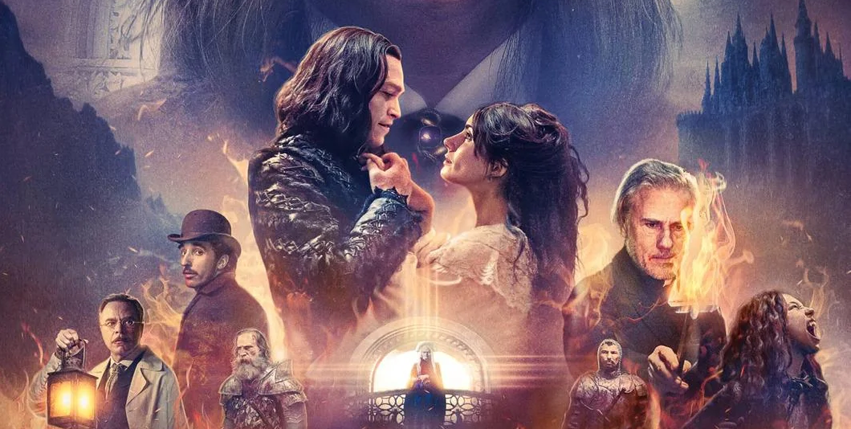
La Femme Nikita director Luc Besson delivers a fun big screen remake of the classic Bram Stoker vampire tale with some A-List talent hamming it up in a unique yet familar take on Dracula.
DRACULA: A LOVE TALE (2026)
★★★ OF ★★★★★ stars
When one thinks of big screen vampire tales, you have to instantly think of films like Francis Ford Coppola’s 1992 film Bram Stoker’s Dracula, considered by many to be the definitive take on the Romanian blood sucker also known as Vlad the Impaler. Takes on the story are always present in cinema, from Tod Browning’s 1931 Universal Monster classic starring Bela Lugosi to 2024’s Nosferatu. Luc Besson, director of films like The Fifth Element, Lucy, Anna and Leon, The Professional tries his hand at this genre and story with DRACULA: A LOVE TALE which hits theaters this Friday, February 6th. Besson’s version of the story starts very much akin to Coppola’s. Dracula is tasked with defending the church, here played by Caleb Landry Jones. Dracula is madly in love with his zany wife, Elizabetta (played by Zoe Bleu). Neither can live without the other and Dracula will only fight for Catholicism as long as his wife is safe; thus all but promising her sudden and inevitable demise. Sure enough, no sooner has Dracula earned the name of the Impaler, that some evil soldiers start hunting her down. This is done in an admittedly fun sequence where she races against the soldiers across a snowfield mined with beartraps. Alas, tragedy strikes and Dracula turns against his God and curses himself to eternal life in the worst way possible. All he wants is love, but he is damned to arcane immortality without it.
Besson’s take is heavily, heavily influenced by Coppola. The art direction, story structure, costume and score all make it seem much more of a rework of the 1992 version, rather than a new take on Stoker’s novel. That being said, it all works in a weird, Tarantino-esque homage sort of way. The score, by Danny Elfman, no less, strikes the type of chord you’d expect from a Dracula film and complements the action. But Besson introduces some other fun homages. Dracula’s bug-eating assistant Renfield is combined with the stereotypical Lucy character here in the form of Maria, played by Matilda De Angelis as a sort of Harley Quinn-esque mad woman that Dracula turned at a royal court hundreds of years ago and now uses as bait to find his resurrected bride. Caleb Landry Jones handles his Dracula deadly serious and insane; think Johnny Depp meets Big Trouble in Little China’s Lopan. His nemesis, an unnamed priest played by Christoph Waltz in the vein of Van Helsing meets Hans Landa, is there to drop information and exposition but he still lends the film some gravitas in a gothy Mary Poppins sort of way. But perhaps the film’s most interesting and fun addition is giving Dracula little gargoyle minions, not unlike the minions from Hotel Transylvania. No, we’re not kidding. It’s wacky, weird but it somehow works in a fun batshit kind of way.
Dracula: A Love Tale is not Nosferatu but it’s not trying to be. It’s unique and has some great visuals and costume design along with some kooky ideas that don’t really gel. But it’s a pleaser with a crowd with a lot of weird setpieces where Dracula controls people throughout the ages with perfume, powers himself up with a horny nun buffet, and a closing set piece where he’s being raided by the Transylvanian army. It’s weird, but this reviewer liked its doesn’t give a fuck attitude.
—
VIDEO REVIEW