
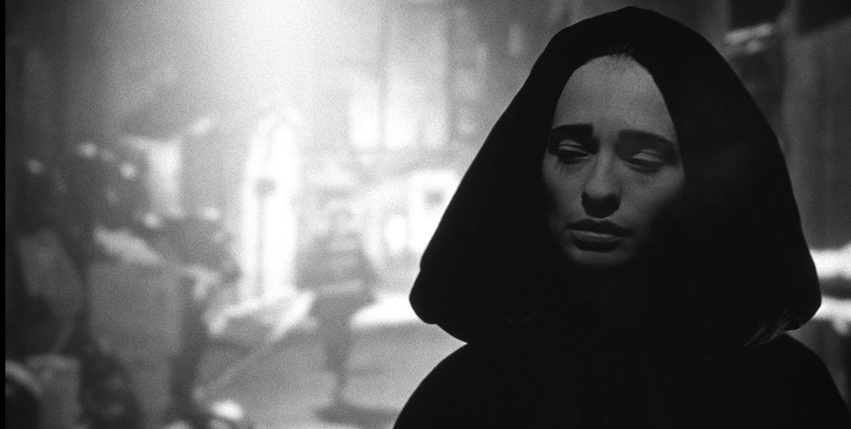
Years before Jim Jarmusch’s ONLY LOVERS LEFT ALIVE, NADJA channelled the hipster cool downside of living the immortal lifestyle of the undead.
NADJA (1994)
★★★ OF ★★★★★ stars
2026 is kicking off with a lot of big screen vampire resurrections – from DRACULA: ALOVE TALE from Luc Besson to the release of the 4K restoration of Michaeal Almereyda’s 1994 vampire elegy NADJA, which hits New York this week and California’s Frida Cinema later in February. Executive produced by David Lynch after financing fell through, Almereyeda’s NADJA follows Nadja, played by Elina Lowensohn, living in New York, having escaped her controlling father but living off his wealth despite her aversion to the leash he has had on her. Almereyda reimagines 1936’s Dracula’s Daughter as a remix of the original Dracula story (Dracula’s Daughter would also be remade in 2024 as Abigail), with Van Helsing, here played by Peter Fonda, hunting down her father and herself in a bizarre and iconically Peter Fonda role. There’s a political subtext with this version of Dracula sharing a name with Nicolae Ceacescu, the former leader of Romania, who had been overthrown and executed not long before this film was shot and a figure that had a complex legacy as a leader, which jives with the vibe they want Nadja to have about her father Dracula.
The most striking things about the film are the vibe of ennui and 90’s detachment that Lowensohn projects as Nadja. If you thought Tilda Swinton nailed the iconic hipster vampire role in Jarmusch’s ONLY LOVERS LEFT ALIVE, Lowensohn asks you to hold her glass as she swoons verse about the emptiness of her existence as The Verve or Portishead needledrops in the background. This film has largely been lost to time, not on physical media boutique labels or on streaming, so Arbelos and Grasshopper Films have largely unearthed a hidden gem here that feels strangely timely. Nadja feels strangely modern; she takes this film’s version of Lucy as a lover in the opening of the film which leads to her vampirism. She feels alone and hunted, never safe, which has an interesting analogy to the queer experience in the late 1980’s and early 90’s. The film’s climax also has a subtextual trans analogy, even then, about finding salvation in one’s true self away from a deadnamed past identity. Fonda’s Van Helsing even plays not unlike the Dafoe take on the archetype seen in Nosferatu; the burned out mystic is not too far a leap from a fried hippie.
The film’s other really striking feature is the stunning black and white cinematography. Restored in 4K, the detail is really rich and the camera loves Lowensohn’s face; she really has a magnetic radiance and you’re taken with her character and her plight. Almereyda implemented a very novel approach for the scenes of violence and lovemaking; two passions exerted equally here, by using a pixellized Fisher-Price toy camera for those scenes. It’s jarring and the effect is meant to show you the difference in the film’s tone. Especially in channeling violence, in the film’s opening vampiric attack, it really work, weirdly enough. But if you enjoy films like Jarmusch’s ONLY LOVERS LEFT ALIVE, Lynch’s work in films like BLUE VELVET or MULHOLLAND DRIVE, or even A GIRL WALKS HOME ALONE AT NIGHT, this film is something you should check out as it makes its way across the repertory film circuit.
NADJA opens February 6th at BAM, featuring two Q&As with director Michael Almereyda, moderated on February 6 by critic Stephanie Zacharek and on February 7 by filmmaker Azazel Jacobs.
It also screens at Feb 21 & 22 at Vidiots and The Frida Cinema in Santa Ana, CA on February 25th and 26th
—
VIDEO REVIEW