
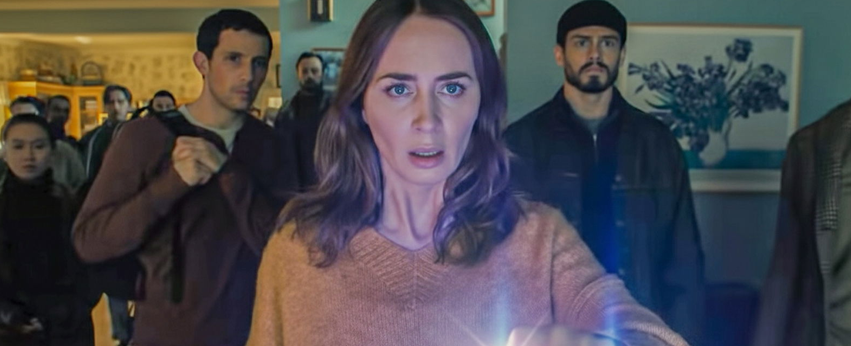
Spielberg’s 35th feature revisits the topic of life on other planets and what it would mean if that were confirmed to be in this geo-political thriller.
DISCLOSURE DAY (2026)
★★★ & 1/2 ★ OF ★★★★★ stars
It’s something amazing to realize that Steven Spielberg has been making feature films for over 50 years. From crowd pleasing blockbusters like RAIDERS OF THE LOST ARK and JAWS, to all-time classics from E.T. and CLOSE ENOCUNTERS OIF THE THIRD KIND, Spileberg’s love for storytelling and his everyman protagonists hacve defined cinemas for generations. DISCLOSURE DAY, which hits theaters this weekend, isn’t a stealth sequel to E.T. or CLOSE ENCOUNTERS OF THE THIRD KIND, but serves as a coda for that era of exploration in Spielberg’s early filmmaking career. The question of “are we alone” and what does it mean are revisisted here in a career epilogue that seemingly asks, if humanity is at the brink now with geo-politics influencing our lives from the spiraling cost of gas to that cost of groceries, would knowledge that we aren’t alone bring us together or tear us apart?
That dichotomy is represented in the film by the character of Scanlon, played by Colin Firth in an unexpected character performance. Scanlon runs Wardex, a top-secret deep-state level agency that’s kept the secret existence of UFOs away from the knowledge of the media and the general populace for years. He believes knoweldge of life on other worlds would break the world and send it into chaos. This is even more prescient as in this film, the world is at the brink of war as North Korea is challenging the status quo and pushing the US into World War 3. In this powderkeg, a hacker named Daniel Kellner (played by Josh O’Connor) has stolen Wardex’s treasure trove of alien encounters, from Roswell footage to Richard Nixon showing alien corpses to Honeymooners’ star Jackie Gleason. Scanlon also realizes Kellner was likely a mole and finds he was turned by Hugo (Colman Domingo) a long-time employee of Wardex and former friend of Scanlon’s. Scanlon considers this a betrayal and wants the data back at any cost – to Kellner and Hugo but also to himself. Kellner is on the run with his girlfriend Jane (played by Eve Hewson), a former novitiate nun who questions if humanity is ready to know about life on other planets because it could break their faith in God if they know there are other beings out there besides their Heavenly Father. And we also have Margaret (Emily Blunt) a weathergirl in Kansas City who can suddenly feel the thoughts and memories and languages of everyone around her and who has an inexplicable link to Kellner. What does that relationship mean and what do Margaret’s powers bode to as far as humanity? These are the questions that Spielberg asks in this everyman look at how humanity would perceive a fundamental shift in our position in the universe.
This film is like jazz to Spielberg; the script and story play to his storytelling strengths of everyday people thrust into uncommon situations and rising to the challenge because of the strength of their character and resolve. Blunt and O’Connor both understand this assignment and really ground this story. Firth’s Scanlon feels like a caricature at times, espeically when using an alien macguffin that largely drives the film’s narrative thrust. Domingo does his best to not make his character feel like its falling into the Bagger Vance/magical caretaker to the white protagonists trope, but it does largely feel that way, even when another character has to tell someone in Hugo’s crew that she won’t be their religion. The cinematography by Spielberg’s right hand Janusz Kaminski is done well, lots of shots of light illuminating Blunt as a savior-esque character – revisiting the way that he shot Samantha Morton’s Agatha in Minority Report. It’s odd that the surveillance state in this film is more fantastical that the fictional one Spielberg envisioned in his adaptation of Dick’s Minoroity Report over 20 years ago. But this film, much like Minority Report, is served well by its cast of actors; one could see how Cruise could’ve played Kellner in another life. Moreover, Spielberg’s third act keeps you glued to the film and the recreations of famous alien encounters in US history littered in this film must have been a hoot for Spielberg to shoot.
DISCLOSURE DAY isn’t one of Spielberg’s best, but it’s a good late career thriller that is a coda to a definitive interested of Spielberg’s he’s explored throughout his career and one worth checking out.